
Choosing among the top ten Dual Channel Syringe Pump options takes more than comparing prices or channel counts. Buyers should examine flow-rate range, syringe compatibility, channel independence, accuracy specifications, alarms, and the effort required to clean and maintain each unit. A pump may look capable on a catalog page, yet prove awkward beside a crowded bench when tubing crosses, syringes need changing, or two flow profiles must run at once.
This guide compares practical details that matter in research, laboratory, and industrial settings. It considers controls, setup, documentation, service access, and the clarity of published specifications. Small details count. A readable display helps during routine adjustments. Clear occlusion alerts can make troubleshooting less confusing. Still, no model is ideal for every workflow; that deserves a closer look.
A useful editorial principle is: “Compare the pump with the protocol, not just with the brochure.” I cannot responsibly attribute that sentence to a named industry expert without a verifiable source. Before publication, add a confirmed expert’s name and an exact, sourced quotation. The comparison should also distinguish manufacturer claims from independently verified performance, where evidence is available. Buyers can then shortlist pumps based on their actual syringe sizes, target flow rates, operating environment, and support needs—not vague claims of versatility.
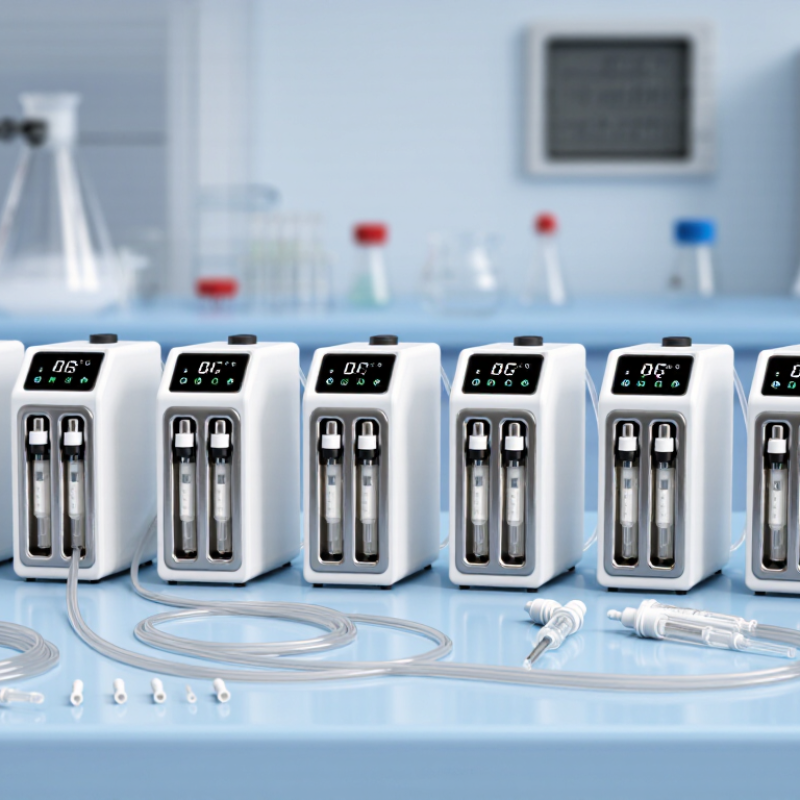
A dual-channel syringe pump moves liquid through two syringe-based channels, each driven by a controlled mechanism. In many designs, each channel has its own motor and settings, allowing separate flow rates or coordinated delivery. The exact controls vary by model, so “dual-channel” does not always mean both syringes can run independently.
The operator loads compatible syringes, secures the plungers, connects tubing, and enters the required rate and volume. The drive advances each plunger gradually, displacing liquid into the connected line. Small details matter. Syringe diameter affects the relationship between plunger movement and flow, while loose fittings or trapped air can affect delivery. For repeatable results, users should check the setup, inspect connections, and verify the selected syringe size before starting.
These pumps are used in settings such as laboratory experiments, analytical workflows, and controlled fluid delivery. One channel may deliver a sample while the other supplies a separate solution, but the intended setup depends on the procedure. It sounds simple, yet low flow rates can make setup errors harder to notice. Tubing compliance, back pressure, and the liquid’s properties may also influence actual performance. A pump’s displayed rate should therefore be treated as a setting, not automatic proof of exact output.
A dual-channel syringe pump uses two motor-driven mechanisms to move fluid from two syringes. Depending on the design, each channel may run independently, follow a coordinated program, or operate in sequence. The profiles below are buyer-oriented configuration types, not ranked product models.
| No. | Configuration | How the two channels work | Typical syringe fit | Common operating approach | Suitable applications | Buyer checks |
|---|---|---|---|---|---|---|
| 1 | Independent dual infusion | Each syringe has its own drive and can be started, stopped, and adjusted separately. | Often supports a range of syringe sizes; compatibility depends on the pump’s clamps and settings. | Set a flow rate and volume limit for each channel independently. | Laboratory dosing, reagent delivery, and two-fluid experiments. | Confirm independent controls, supported syringe sizes, and per-channel limits. |
| 2 | Coordinated dual infusion | Both channels deliver at the same time, with separate rates or a user-defined relationship between rates. | Matched or different syringe sizes may be supported, subject to the device configuration. | Run simultaneously; some systems allow linked settings or synchronized starts. | Combining reagents, parallel dosing, and controlled mixing at a downstream junction. | Check whether rate linking is available and whether the intended tubing and mixer are suitable. |
| 3 | Equal-rate parallel delivery | Two channels are configured to deliver at matching target rates; each still uses its own syringe and drive. | Use syringe types and sizes permitted by the pump; equal rates do not necessarily mean equal delivered volumes over different run times. | Set matching rates and verify both channels before starting. | Parallel delivery where matched flow is important. | Ask how the device defines rate resolution and accuracy for each selected syringe. |
| 4 | Ratio-controlled delivery | The two channels deliver at a selected rate ratio, such as one channel running faster than the other. | Syringe selection should account for the required volume and flow on each channel. | Set two rates directly or enter a ratio if the controller supports it. | Preparing mixtures with a controlled feed ratio. | Confirm ratio programming, rounding behavior, and how the pump handles a channel reaching its limit. |
| 5 | Sequential or alternating delivery | The controller runs one channel and then the other, or alternates according to a programmed sequence. | Each channel must accept the syringe size and fluid volume required for its step. | Use timed steps, volume-based steps, or manual channel changes where supported. | Multi-stage protocols and alternating delivery of different solutions. | Check the number of programmable steps, pause behavior, and restart options. |
| 6 | Infusion-and-withdrawal configuration | One or both channels may be configured for dispensing or withdrawing, if the pump supports bidirectional operation. | Compatible syringe size and plunger geometry are model-specific. | Direction is set through the control interface or a programmed cycle. | Sampling, fluid exchange, and laboratory procedures that require aspiration as well as dispensing. | Verify bidirectional operation explicitly; it is not a standard feature on every syringe pump. |
| 7 | Low-flow research configuration | Two channels provide separately controlled delivery for experiments that need small, gradual fluid additions. | Smaller syringes can support lower-volume work, but usable performance depends on the pump and syringe combination. | Set a low target rate and use appropriate tubing and connections. | Microfluidics, analytical research, and small-volume reagent delivery. | Review minimum controllable rate, step size, backlash, and the effect of syringe selection on delivery. |
| 8 | Higher-throughput delivery configuration | Two channels deliver fluid in parallel when the required combined output is greater than one channel alone can provide. | Larger syringes may be used if supported by the device; syringe size alone does not determine the maximum flow. | Run both channels together, while observing each channel’s rated limits. | Applications requiring parallel delivery of larger fluid volumes. | Check the maximum rate per channel, motor force, duty cycle, and pressure limits for the intended setup. |
| 9 | Programmable multi-step configuration | Both channels follow stored steps, which may include different rates, volumes, pauses, or start times. | Each programmed step must remain within the supported syringe and operating range. | Enter a sequence on the pump or load it through supported control software. | Repeatable protocols, method development, and automated test procedures. | Confirm program capacity, data retention, alarms, and whether steps can be edited during a run. |
| 10 | Externally controlled or integrated configuration | The two channels are operated through a host controller or incorporated into a larger instrument, when communication interfaces are provided. | Syringe compatibility remains specific to the pump head and mechanical design. | Use supported digital or analog commands; available interfaces vary by system. | Automated test stands, instrument integration, and remotely controlled workflows. | Check interface documentation, command set, electrical requirements, and emergency-stop behavior. |
Selection note: Flow range, accuracy, syringe compatibility, pressure capability, and control features vary by model and by syringe, tubing, fluid, and setup. Treat published specifications as device-specific and verify them against the intended application before purchase. A dual-channel pump provides two syringe drives; it does not, by itself, guarantee that two fluids will mix uniformly.